Thursday, November 29, 2007

Resisted sprints with bungee cords

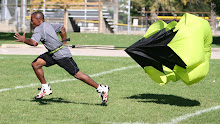
Resisted bungee sprints are a fantastic way to improve sprint speed and acceleration! The bungee cords allows for smooth resistance as an athlete sprints forward while wearing belt and bungee cord unit.

Resisted bungee cord sprints aid in leg drive, acceleration, and first step quickness.

Check out the video below for a sample of what resistance sprints with bungee cords can do:


When using bungee cords for resisted sprints, remember to:

  • use arm action and good knee punch
  • stay on your power pads
  • lean with your body position starting at your ankles

Looking for a good bungee training device? Check out the cost effective Viper Bungee that allows for 360 degrees of movement by clicking here.

Wednesday, November 28, 2007

1 legged lateral hops for better performance

Single legged lateral hopping drills are great for helping an athlete to increase:

  • balance and stability
  • ankle and leg strength
  • coordination

They are also useful for an athletes agility, training the action of "planting" on one foot with each hop. Most single legged drills are performed moving forwards and backwards, but the forgotten direction is moving laterally.

Hopping laterally on one foot adds another dimension to one legged training, since many athletic actions are performed multi-directional---playing forwards, backwards, sideways, with constant changes of direction. Training to move on one foot laterally also helps to increase an athletes ability to change direction quicker, wasting no movement as they explode from one place to another.

Here are some tips in incorporating one foot lateral hops into your training:

  1. focus on landing on your "power pads" (forefoot), not flat footed
  2. bounce softly off the ankle, pushing sideways upon each ground landing
  3. keep knee slightly bent so it acts as a shock absorber
  4. keeps hips, knees and shoulders square, with head on a swivel
  5. arms must stay relaxed with arms slightly bent (no arm swimming!)
  6. set a distance of about 5-10yards
  7. move in both directions (to the left and right) with each foot

Check out the above video, and add the single legged lateral hops to your routine, and watch it pay off!

Monday, November 26, 2007

Using the Quickness ladder for different foot strikes


Using the Quickness Ladder to increase foot quickness, speed, and coordination is vital for today's performance athlete. But moving through the ladder should not simply be a matter of just running through it.


To get the most out of your Quickness Ladder, move through the ladder with different foot strikes such as cross over steps, carioca, and hop scotch. Foot action which forces the hips to open up and move throughout the drill is a great way to involve the hips with the foot action as you perform athletic actions.

Here are a couple of great drills:
  1. zig zag step laterally through ladder, stepping backwards out of the ladder
  2. zig zag step laterally through ladder, stepping forward out of the ladder
  3. 2 in 2 out, stepping forward through ladder alternating feet in every rung space
  4. carioca laterally through the ladder
  5. scissors steps laterally through the ladder alternating feet in each rung

Try these drills to see if you can get your feet stepping quicker at different angles. A Q Ladder can be purchased at ProPowerTraining.com.


Tuesday, November 20, 2007

Wood chops for "function"


Cable wood chops are one of the best functional movements for athletes. "Functional" is the buzz word in sports performance training as of late, and refers to exercises that are performed and contribute to how an athlete actually plays.

Performance with power, strength, balance and flexibility---these are the signature traits of athletic prowess. Wood chops help to train the total body's "function" by utilizing arms, hips and the core. Cable wood chops can be done with the pulley in a high position fixed above an athlete, or below an athlete coming from the near ground level.

The action involved---"wood chopping"---helps an athlete used their total body in the drill, from the base of the foot to the hands.

Another variation to this drill is to use a medicine ball inside of a sling to hit off the surface of the ground at the same angle you would move in the cable wood chop. Tubing attached to handles can also serve the same purpose by a connecting the tubing to a fixed stationary object as you perform wood chops.

For a good workout, select a moderate level to start at--either with the weighted cable or in choosing the weight of the med ball or tension of the tubing. Perform 3-4 sets of 8 reps of wood chops to both sides (choose either from high or from low position).

Add the wood chop to your workouts to get to new heights!

Hurdle-Cone touch combo drill

This is the ultimate quickness drill! The drill involves stepping over hurdle, then with an extended reach to your right touch cone, then to your left and touch cone. After touching second cone, continue over hurdles until you reach the end of the drill.

Check out the video for the drill in action!

Monday, November 19, 2007

Box Step ups for strength and function


Utilize DB box step ups in your workouts to create more sports specific strength and function in your training!

Take a moderately heavy DB in each hand and place one foot on a box, bench or step. Driving off the elevated foot, stepping onto the surface and driving your opposite knee up with your toe pointed towards the ceiling. Step down and repeat with the same leg.

Perform about 3-4 sets of 8-10 reps per leg.
Box step ups are good for strengthening leg drive in the knee and hip joint as well as creating a more stability in athletes. For a change up, try perfoming this drill and alternate each leg as youstep up.

Friday, November 16, 2007

Getting in the Zone


Listen to top NFL rookie Adrian Peterson talk about getting into the zone.

Side Lunges for athletes


Most serious training athletes know about the benefits of lunges. They can be performed forward and backwards, either stepping to the front and then with feet back together, or stepping to the rear, then with feet back together again.
Lunges can also be done over a certain distance by stepping forward or backwards continuously for a set distance.
Lunges are great for athletes, especially walking lunges, because they work hips, hamstrings, quads and glutes.
Side Lunges are the often forgotten lunges. They add another element to the lunge factor by having the athlete step to the side. YES, you still work hips, glutes, hams and quads, but at a different angle--to the side.
Try it with with moderate weights first, with about 3 sets of 8-10 reps per leg. Perform all reps of one leg before moving on to the next leg. Step out to the side, and back to your original position. Repeat.

Wednesday, November 14, 2007

Train and Track it


Any athlete training for success should track their training in a written, documented format! Using a log book is a great way to track your training from workout to workout. There are several great reasons for tracking your workouts using the written word.

Tracking workouts allows your to measure your progress when it comes to training loads, conditioning distances, exercises and drills. It enables an athlete to look back over previous workouts for strengths, weakness', and to review past exercises/drills to possibly do again (or NOT do again!)

Things that should be tracked in a workout log include (but is not limited too:)
  1. Sets, reps and load weight of a specific exercise.
  2. Rest interval between sets
  3. Distance athlete sprints, hops, runs, jogs, etc.
  4. Specific exercise and drills (ea.: squat, plyometrics, bungee jumps, bench presses)
  5. Training location, date and time

There are a lot of great workout journals on the market today (such as the featured "Ultimate Workout Log" by Suzanne Schlosberg), but honestly, any note book will do. Simple break your page down to feature the columns you desire such as:

  • sets, reps, and amount of weight
  • exercise or drill type
  • performance tool used (Dumbbell, parachute, med ball, etc.)
  • workout goal that session (total body, plyometric, etc.)

There are lots of other columns that can be used and added, but this gives you the general idea. However there is one rule----no substituting a computer for a log book! Tracking of your workouts as you train makes it more personal and less "clinical" as if it's being done in a lab as opposed to grinding away in a workout facility.

Train and Track it!

Tuesday, November 13, 2007

Box Jumps help aid in explosive power

Box jumps take plyometric training to another level. Your aim does not have to be an increased vertical jump to use box jumps in your athletic arsenal of traininng. Box jumps aid athletes in developing lower body power, stability, coordination and balance.

A good way to start is with the single explosive box jump and step off. Here is how it works:
  1. Select an adequate box height to start with
  2. Set your feet with a good athletic base, normally about shoulder width apart
  3. Use your arm action to propel you upwards as your hips explode from a slightly lowered position and raise your feet with good knee bend.
  4. Land softly on your 'power pads' on the surface of the box.
  5. Step down and repeat.

Total number of sets and reps vary, but a good place to start would be about 4 sets of 5 jumps per set. Allow about 90 seconds to 2 minutes to recover between each set to get the maximum out of each set. Wanna set it? Check out the vid below:

Friday, November 9, 2007

Viper Bungee alows for swivel action

The viper Bungee offered by Pro Power Training enables athletes to have a 360 degree range of mation as they train. The unit is designed so that athletes can perform one action, such as a shuffle, then immediately switch body position and move either forward or backward.

Drills
Numerous drills and sports specifc actions can be performed using the Viper such as:
  1. Shuffle laterally for a certain distance, then swivel, and backpedal back to starting point
  2. Sprint forward, swivel, and shuffle back to starting point
  3. Perform a standing broad jump, land and swivel, then shuffle back to starting point

The following is a fantastic drll for quickness and change in body positioning:

  • Set up 4 cones 3-4 yards apart
  • shuffle from cone 1 to cone 2, then swivel and sprint back to cone 1.
  • Immediately shuffle from cone 1 to cone 3, then swivel and sprint back to cone 1.
  • Lastly, shuffle from cone 1 to cone 4, then swivel and sprint back to cone 1.
  • that completes 1 set!

For some variety options, switch around the shuffle and sprint actions in the drill.

The Viper is a fantastic training device with many sport applications. Grab one at ProPowerTraining.com.


Thursday, November 8, 2007

3 factors to consider in designing sports performance training programs

Designing a quality sports performance training program requires a basic understanding of program design. 3 key factors that come into play are: Program Goal, Tools, and Scheduling.

In factor number one, determind the performance goal: are you looking to get faster, bigger or stronger? Wanna add a couple of inches on to your vertical jump or get a quicker first step?

After you decide the goal of your program, next see what types of equipment you have at your disposal that can help you attain that goal. If your goal is strength and power, check your arsenal for weight equipment, medicine balls and resistance bands. If speed and acceleration are your goals, you may wanna go through your inventory for speed chutes, resistance sprint leashes, etc. (a great line of performance equipment can be found at Pro Power Training.com)

Next, determind a good workout schedule. Is this your in-season, off-season, or pre-season? Does your time permit you to train 3, 4, or 5 times per week?

Lots of other factors come into play when designing a good training program, but these are 3 to consider when designing a training program. This same appraoch is not limited to indivdual athletes---coaches can weigh these factors when designing and implementing team programs as well.

Tuesday, November 6, 2007

Sports Training Facilites in the US

Sports Performance Training facilities align the cities of our nation, preping athletes to get faster, quicker, and stronger. Check out the two video tours of two of the countries best---SPEED STRENGTH and ATHLETES PERFORMANCE.


Bungee training with hops

Use a bungee cord to train forward/backwards motion, while mixing in different athletic actions. Here is how:

Place to cones about 5-7 yards apart near a secure object. Put a belt around your waist that is attached to a latex bungee cord (you can find one at ProPowerTraining.com). After attaching bungee unit to yourself and a secure object, and perform a backwards one legged bunny hop to it. As soon as you reach the cone, IMMEDIATELY perform a backwards run to the starting cone. Repeat.

Perfom this back and forth action to the cones 4 times, only counting each rep when you reach first cone. See sample video below:


The Drill can also be performed by bunny hopping in both directions (see below)


Check out the vids and add the drills to your performance training.


Parachute Training tip:

Monday, November 5, 2007

Combining hurdles with athletic actions


Use hurdles in buidling a great change of direction workout by performing a different athletic action once you leave the hurdle behind.


For example, perform a lateral stepping action, followed by a 1)sprint, 2)shuffle, 3)backpedal.


Check out these great samples of video, and implement them into your workouts today!


Friday, November 2, 2007

Mind Training


Get your mind right! There are tons of books out there on the topic of sports psychology, and sometimes you almost have to be "Freud" to understand them, then attempt to apply the information contained inside each book.

"Mind Gym" by Gary Mack hits the nail on the head. Rather then a bunch of jargon and psych talk, Mack offers simple formulas for getting your mind into the performance zone by creating and capitalizing on your very own "Mind Gym".

The books is not a long drawn out sports psyching book, but rather is broken down into "tidbit chapters" of information that can by quickly applied.

Pick it up at your local retailer, or visit http://www.amazon.com/ (amazon has a feature that allows you to check out actual pages inside the book!)

Get your MIND right today!